Over the past few weeks we have seen a rush for quick quotes and blueprint estimating in our office. One huge advantage of working with us here at R.C. is just that, the ability to get a list of material quoted quickly so that you can get your quote back to the customer in a timely fashion. But, the main advantage is “project pricing”. If you call us and quote material piece by piece, that is fine, you can total the job and get budget pricing. But, if you want to be more competitive, and beat out those contractors who are quoting material from Lowe’s and Home Depot and the other guys, you can and should send us the complete material list or plans and we can extract entire job pricing and help you get the job. Another advantage to this is an extra set of eyes and knowledge examining the project before it begins. The more detail and care that is put into the planning stages, the less headache, surprises, and lost $$$ there are throughout construction.
The biggest advantage of having us work for you is that you can spend more time on the job, following up with your customers, and ensuring quality customer service. The best time to take advantage of this is in the early planning stages of a home addition. We have the know-how and experience of working with engineers and architects to make sure you are getting quality work and that adjustments and changes are never seen as a roadblock to your success as a builder. We want to help make any changes the homeowner wants go smoothly down a path to a great finished product. We invite you to see the difference. On your next job big or small, get a complete job price from one of the other guys, and then get it from R.C. Goodwyn’s, we promise you will be glad you did. Remember, with our experience, you are getting so much more than a good price to help you get the job. You are getting reliability, familiarity and accountability - we are here to make you more money and ensure the entire job goes as planned.

TOP 5 REASONS EVERY RENTAL PROPERTY OWNER IN CENTRAL VA SHOULD KNOW RC GOODWYN'S

1. Save $$$$$ with an account. I know, it seems pretty obvious and cliché, but it is so very true at R.C. Goodwyn's. If you set up an account and pay on time, you can receive up to 2% off at the end of the month. BUT, MORE importantly --- as you begin to purchase more to keep your rental property top notch...(light bulbs, air filters, porch posts,sheetrock,plumbing parts, tools ...ect,ect..) you will start to get great discounts up front when you pick items or have them delivered.
2. We can answer your plumbing and electrical questions. Every time your renter calls you with a problem, you can rest assured that you don't always have to call a plumber or electrician. It very well may be you can fix it yourself with a little guidance. This can make you feel more comfortable about your investment and increase your bottom line. Never again wonder if you wasted money calling a pro when it was unnecessary, consult us first.

3. We have quality and affordable light fixtures, fans, and faucets AND PAINT for your rental property. Don't pay too much at Lowes and Home Depot for this stuff, it is RENTAL PROPERTY. We can get exactly what you need to keep your renter happy! DID WE SAY WE HAVE PAINT?


4. WE DELIVER QUICKLY and CAN GIVE YOU QUALITY REFERENCES. Our service is the best If you need to make a major improvement, like a new deck. We can set you up with a quality carpenter and make sure your project goes on schedule and is up to code. The longer your rental home is empty, the more it hurts your bottom line.
5. Selection. We have access to over 60,000 items in home improvement at very competitive prices. Just go to www.goodwynhardware.com to see. All you have to do is call or email us with the items you want or are interested in us potentially stocking and we can guarantee you will save money immediately. You could buy common items in bulk, or one at a time. Spend a few minutes using the search box at the top and see what you can find. Have your items shipped directly to you or pick them up here. We guarantee your satisfaction, and if you are not happy with an item - return it - no questions asked.
By Tim Powell
Whether building starter homes, mid-price residences or high-end custom homes, managing costs is critical at every step. At the same time, cut too many corners and you’ll end up with unhappy customers.
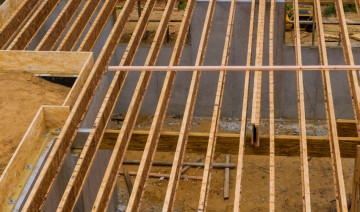
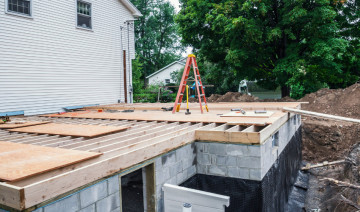
For structural framing in the floor, there’s an easy way to reduce material costs while maintaining or even improving performance. In essence, using fewer materials overall, yet creating a more solid-feeling floor.
The key is to look at the floor framing as a system – joists and floor panels - are designed and installed to work together. These elements can be sized and spaced in numerous ways that effect the finished floor’s feel and cost. Often, though, such decisions are made based solely on previous experience or regional traditions. The result can be a structurally sound, code compliant floor, but one that feels softer than preferred, has squeaks or costs more than it should by not optimizing materials.
With readily available design and evaluation tools, builders can consider multiple floor framing plans and pick the best one for their needs before construction begins. In affordable homes, a builder may choose a lower-cost floor option designed to code requirements, but may want a more solid floor in higher-end homes. Within the same home, the owners may be fine with a basic floor system in the office or other low-use rooms, while desiring a higher rating in living rooms and kitchens where traffic and visitors are more frequent. Whatever type of floor is needed, design and evaluation tools can help balance floor performance with costs.
One such tool available to builders through dealers is iLevel Javelin® design software. Designers can use the program to analyze various options for joist size, spacing and span, along with floor panel thickness, to help target floor performance to its intended use. Built into the software is the TJ-Pro™ Rating system, which provides a single rating number for each floor or framing area in a home which indicates how most users will perceive the floor’s feel. The software provides a detailed framing plan that shows the precise location and size of all structural materials, along with a material list. This helps avoid unnecessary material and labor costs inherent with overbuilding or from ordering too many materials.
A specific floor system solution that works well in many applications is to use thicker floor panels in conjunction with wider joist spacing. For example, builders may be able to substitute 7/8” iLevel® Edge Gold™ OSB panels for 22/32” OSB panels and increase joist spacing from 16” on-center to 19.2”. Such floor systems usually have a higher TJ-Pro Rating because the thicker panels are stiffer and better dampen vibration despite the wider joist spacing.
While 7/8” panels cost more, the total floor framing cost is often less because fewer floor joists are needed. Thicker panels also can help reduce the risk of callbacks by better resisting edge swell if the subfloor gets wet during construction – which can lead to buckling in hardwood floors. As with all structural framing, it is important to confirm that local codes allow wider joist spacing in conjunction with thicker panels.
Beyond the joists and panels, rim board selection also plays an important role in the cost versus performance equation of a floor system. Rim board provides attachment points for joists and floor sheathing and helps carry and transfer vertical and lateral loads. To do this properly, it must be the same depth as the joists. Because dimension lumber rim typically shrinks and does not match the depth of the wood I-joists it is not recommend for use with I-joists. As an alternative, many builders use LSL rim board. Products like Trus Joist® TimberStrand® LSL rim board match the depths of TJI®-joists and are dimensionally stable, strong, consistent and resist warping and twisting. The result is a floor that’s more likely to remain quieter and more firm well after installation.
Getting started with designing and building floors as an integrated system is easy. Your building material dealer or manufacturer can assist with information on the latest products and construction methods, as well as design tools and performance ratings. Some also have on-staff engineers who can work with you to help ensure a cost-effective, quality floor.
Tim Powell, is a National Accounts Manager for iLevel by Weyerhaeuser. iLevel offers a range of residential, multi-family and light construction structural framing materials, technical support and software, including TJI® joists, iLevel Edge Gold™ panels, TimberStrand® LSL, Parallam® PSL and iLevel Premium® Joists. www.iLevel.com, 888-453-8358
By Mike Holmes, Postmedia News
If you drive around any new subdivision being built in North America, I’m sure you’ll see a lot of wood. Most of our houses are framed, structured and sheathed with wood. And it shows up in windows and doors, exterior siding and interior finishes, such as flooring, trim and cabinets.
Standard house construction methods develop as a result of what products are most available in the area. And in North America, wood has always been plentiful and easily accessible, so it makes practical sense to use it. Over 95 per cent of the softwood used in residential construction is grown here in North America.
You want to make sure that any wood products used in your home — from framing to finishing — come from sustainable sources and is certified by a third party. There are several different systems of certification, all of which exist to ensure that the wood consumers are buying is grown and harvested in the most responsible way possible.
There are many independent forest-certification standards around the world, but in Canada, the best are FSC (Forest Stewardship Council), CSA (Canadian Standards Association’s Sustainable Forest Management Standards), and SFI (Sustainable Forestry Initiative).
Currently, only a small percentage — around 10 per cent — of the world’s forests are certified. That’s not a lot. But, of that relatively small amount, almost half are in Canada.
In order for wood to meet the standards of any of the certification systems, the forest needs to be properly managed. That includes ensuring the environment is protected, the harvest is managed at sustainable levels, logged areas are reforested and replanted, biological diversity is maintained, and watersheds and wildlife habitats are protected.
Certified forests are strictly regulated and require independent third-party audits, annual reports that are publicly disclosed, and often will provide CoC (chain of custody) certification, where the wood products are tracked from the original source all the way to the consumer.
I love to build with concrete, and I’ve said so many times. I like concrete because it’s durable, recyclable and both mould- and fire-resistant. But I can’t deny the fact that concrete, like steel, has a lot of embodied energy in it. That means it takes a lot of energy to quarry the stone (e.g., limestone, chalk, slate, silica sand) and process it to make cement, and ultimately, to distribute and build with it.
Wood doesn’t need much processing to make it usable, and it’s lighter to transport — all of which adds up to a lighter carbon footprint.
I do build with wood. Even in a concrete house, there will be some wood used in the construction. I use dimensional and engineered lumber. It’s used in my houses, from framing to finishing. It’s durable, adaptable to many uses and purposes, and it’s recyclable. I believe in using sustainably sourced wood products, and reducing lumber use in general by framing efficiently and reducing waste on site.
I’m a fan of BluWood, which is mould- and insect-resistant, and I use it in framing and sheeting. I use engineered lumber whenever possible, which outperforms conventional solid sawed lumber. It’s made from “undesirable” weed trees and actually uses more of the tree, so it creates less waste. It’s a great product: It’s stronger and more stable and uniform than dimensional lumber.
It makes practical sense to build with wood in North America. We should use responsible, renewable resources whenever possible in building, and wood is clearly renewable: It grows. It also makes green sense. Forests act as carbon sinks, so the more trees we grow, harvest and replant, the better for our environment.
Catch Mike in his new series, Holmes Inspection, airing Thursdays at 8 p.m. ET/PT on HGTV. For more information, visit www.hgtv.ca.
Parallam Plus® with Womanized® Preservative Protection is the perfect solution.
What is that bright fiery ball in the sky? Could it be that spring has finally arrived? That can only mean one thing — deck building season. iLevel is here to help with the quality, long-lasting solutions customers want.
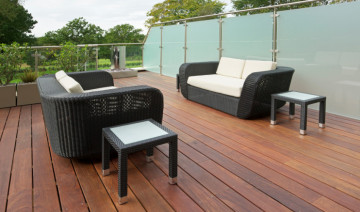
Parallam Plus® PSL with Wolmanized® preservative protection is an ideal structural solution for unprotected exterior applications including decks, retaining walls, carports, pool enclosures and other outdoor shelters. The beams and columns are strong, straight and consistent for applications where the wood comes in direct contact with the ground or moisture, including saltwater splash. Parallam Plus PSL has unique characteristics which allow preservative treatment to penetrate to the core helping protect against termites, fungal decay and eliminating the need for field treatment if cut or drilled. Parallam Plus PSL can be painted or stained with an oil-based finish to give any look you want.
Parallam Plus PSL addresses multiple exposed structural lumber applications and enables greater design flexibility and while delivering long-term durability even in the harshest conditions. Learn more at http://www.ilevel.com/exterior/e_ParallamPlusPSL.aspx
From Ilevel Insights
by John Kirchner
Let’s be honest – the best part of spring cleaning is wiping away the dingy film of winter and unveiling the brisk feel of spring. Nothing is more emblematic of this transition than window washing. Before you break out the toxic window cleaner and squeegee, let’s talk over a few pointers for squeaky clean, non-streaky windows.
Borrowing our tips from the pros, we’ve found a three-step approach that will polish windows to perfection.
- Before you begin, a few things to consider:
- Time window washing to cloudy days – bright sunlight causes the windows to dry too quickly, which may cause the dreaded streaks
- Wash each window individually – streaks increase as you try to tackle more than one surface.
- Gather your supplies:
- Two spray bottles (we caution against using buckets to mix or apply these solutions; you’ll spread the mess with each dip in a bucket.)
- Organic dish detergent
- Water
- Vinegar (organic if you prefer)
- Flour sack cloths (They can be purchased online and are reusable for years.)
- Prepare your solutions. Combine 32 ounces of water with four to five drops of organic dish detergent in a spray bottle. Also, prepare a mixture of three parts vinegar to one part water for the second spray bottle.
- Mist the window with this dish detergent mixture. This mixture breaks down the grease that has accumulated on the windows – very helpful for kitchen windows.
- Immediately follow this by spraying the vinegar mixture on the window. Vinegar is a solvent and it will break down the soap from the first step so you’re not leaving a soap residue. However, on its own, it won’t break down the grease.
- Buff the window dry using a flour sack cloth.
- Follow the same process for the outdoor side of ground-level windows.
Consumer preferences are examined in the latest studies conducted by the NAHB and Better Homes & Gardens.
Source: BUILDER Online News Service
By John Caulfield
The trend among buyers favoring smaller homes with open and multifunctional rooms continued in 2010. But subtle changes in tastes, combined with ongoing shifts in household occupancy, could give alert builders and their product suppliers new opportunities over the next few years, as the housing market recovers and home buyers get back in the game in larger numbers.
Fresh surveys of consumer preferences, presented during a seminar on that topic at the International Builders' Show in Orlando, Fla., on Thursday morning, provided an in-depth look at what consumers are shopping for now and what they might be looking for in the future. While there were no eureka moments in the survey's findings, they reaffirmed demographic factors that are influencing what is getting built these days and made clearer what features home buyers are seeking.
At the very least, consumers are approaching the home buying experience with a different attitude. "The sense of entitlement that people used to feel about having everything they wanted in their homes is being replaced by a sense of gratitude for things they already have," says Jill Waage, editorial director of Better Homes & Gardens' Home Content Core.
Rose Quint, NAHB's assistant vice president for survey research, laid the groundwork for this seminar by sharing projections about household formation and new-home construction. Projections of population growth–which is expected to rise to 322.4 million people in 2015, 336.8 million in 2020, and 422.6 million in 2050–suggest that demand for housing should remain vital. Over that time span, America's Hispanic population will increase to 30% of the total, from 16% today; and people over 55 years old will account for 31% of the total, from 25%.
Houeseholds are getting smaller, too. One- and two-person households represented more than 63% of all households in 2010. And for the first time, married couples accounted for less than 50% of households, while unrelated adults living together increased to 6.2%.
In light of these statistics, the average size of a home completed declined last year to 2,377 square feet, from 2,438 square feet the previous year and 2,570 square feet in 2007. But Quint pointed out that the average size of a home started last year actually inched up a bit to nearly 2,400 square feet, although most of the bigger homes were started in the South and Midwest. "So this is by no means an phenomenon," she said.
Quint shared new research in which the NAHB asked builders what they would be building in 2011. More than half, 52%, will build smaller homes, and nearly three fifths will build houses with less expensive price tags. Looking ahead to 2015, three quarters of the builders polled thought that single-family homes would continue to shrink (to around 2,152 square feet, on average); 68% thought they would be more energy efficient; but only 29% expect houses of the future to include more technology.
These builders expect that more one-story homes will be built, and more than half expect houses to combine living rooms with other rooms, with family rooms getting larger. (Thirty percent thought living rooms, per se, could vanish altogether). Among the features builders think more homes will include in the coming years are great rooms, low-E windows, double kitchen sinks, and programmable thermostats; indeed, a sizable percentage of builders expect more homes to be Energy Star rated.
However, 61% of builders polled expect the number of features offered as standard to decrease (compared to 32% who were asked the same question in 2007).
Waage followed Quint with a presentation that focused more specifically on the kinds of rooms and features buyers prefer, based on a survey, conducted last December, of 2,000 of her magazine's readers who identified themselves as either planning to buy or remodel a home.
The survey found that buyers may have downsized as much as they're going to, as 40% said their next home would be larger than what they live in today. Buyers are still looking for an affordable and energy efficient home with lots of storage space, but those criteria are slightly less important than they were for survey respondents in 2009.
Waage showed data that indicates buyers are taking a lot longer researching purchases and projects than they did only a few years ago. They are also prioritizing features, with efficient HVAC systems and appliances topping the list, followed by decks and patios, low-maintenance exteriors, and private backyards. They're doing the same prioritizing for living spaces, with separate laundry, office, and storage rooms being most coveted.
However, don't expect home buyers to overextend themselves: Better Homes' survey found that 58.4% of readers polled are "extremely reluctant" to spend money they don't have.
John Caulfield is senior editor for BUILDER magazine.
--------------------------------------------------------------------------------
By: Matt Goodwyn
These famous words have never been so true when talking about the building supply industry. We have just been through a serious downturn, and now we are finally beginning to see a tiny light at the end of the tunnel here at RC Goodwyn’s. Although the industry may never return to where it was, it will come back to a sustainable level and we are ready for it. We have to be more nimble and educated than ever about different supplies, codes, energy efficiency, and especially new products. We have worked hard over the past two years to become more efficient at what we do and now we will see that knowledge carry over to our customers in the years to follow which means builders can make a better product at a lower cost and homeowners can be more effective as DIY er’s and learn more about how to accomplish jobs around their homes.
One of our goals at RC Goodwyn’s is to be there every step of the way as you plan and accomplish your project. We want any interaction you may have with code officials, subcontractors, or even our own salesmen and vendors to go smooth and have as few roadblocks as possible. We know projects change, new and better ideas happen, and we want you to know we are here to help. We think now is a very good time to consider a renovation or addition on your home and we have the very best contractors to help you with ideas and cost estimating to help you make informed decisions about what a renovation project can mean for your home in the long run.
We have worked very hard to become a business you can trust and we will only set you up with experts that we personally guarantee. So whether you need a new roof, new siding or a new patio or sunroom, or just want to begin brainstorming and learn about new products, start here at R.C. Goodwyn and Sons. We have the knowledge, reputation and low pricing to make you feel good about improving your home.
Here are some links to our suppliers and vendors. Each one will open in a new window. You can visit them to see the quality of the products we keep in stock or can order for you.
rockwell tools
dewalt
freud tools
min wax
ram set
tapcon
irwin
diablo tools
grip-rite
fastener connection
paslode
stanley tools
dap
liquid nails
romexint
cooper lighting
olympic
elmers
louisville ladder
thermatru
I saw this today in INC. magizine and thought it was really good...may we strive to make these habits our own.
RCG
The 5 Habits of Quality-Focused Companies
Superior execution is often at the heart of small business success. Here are five ways to ensure that your team is prepared to achieve excellence.
By Inc. staff | Jan 31, 2011
To be successful project to project over a period of years, a company has to develop habits that instill a passion for quality in all corners of the organizations.
Most small businesses achieve success not because they bring a truly innovative idea to market, but rather because they dazzle customers with excellent service. Yet a focus on superior execution—that is, on quality—is easier said than done. To be successful project to project over a period of years, a company has to develop habits that instill a passion for quality in all corners of the organizations. Here are five habits of organizations that focus on quality. Would you say that your business has developed them?
1. They set clear expectations.
To achieve quality, you have to define it, and you have to make sure that definition is disseminated throughout the rank and file. "It's the job of any business owner to be clear about the company's nonnegotiable core values," says restaurateur Danny Meyer. "They're the riverbanks that help guide us as we refine and improve on performance and excellence. A lack of riverbanks creates estuaries and cloudy waters that are confusing to navigate. I want a crystal-clear, swiftly flowing stream. Riverbanks need not hinder creativity, and in fact I leave plenty of room between the riverbanks for individual expression and personal style."
Dig Deeper: How to Set Standards
2. They collect and analyze data.
Collecting data is more common than ever, particularly with the advent of Web analytics. But companies that focus on quality have long stood out thanks to their passion for data. Moreover, the metrics they track go above and beyond either web or financial information. For example, Inc.'s John Case wrote a profile of Granite Rock, a phenomenally successful quarry (yes, quarry) in 1992. Customer surveys played a major role in the company's governing philosophy, with information collected at all kinds of intervals, and results shared widely among the quarry's 400 workers. "The role of managers," Granite Rock CEO Bruce Woolpert told Case, "is to make sure there's a flood of information coming into the company." Would you say that this was true in your business?
Dig Deeper: How to Use Online Tools for Customer Surveys
3. They invest in capacity.
An organization stretched thin on resources will never be able to overdeliver, and quality depends somewhat on the ability of a company to exceed expectations. For that reason, "we create infrastructure in anticipation of revenue," says Dawson Rutter, president of Commonwealth Worldwide, a Boston-based limousine company known for exceptional service. "That ensures service delivery will be impeccable 100 percent of the time. We can always handle 105 percent of our absolute busiest day. Is that a more expensive way of doing it? You bet. But the fact is we don't lose customers, which means we can afford to pay that premium."
Dig Deeper: One Company's Quest for Perfection
4. They promote from within.
Hiring can be a crapshoot, even with the most formidable screening systems in place. So companies with a focus on quality know that one of the keys to success is to develop talent from within. Begin by looking for current employees who possess the characteristics of your best performers, and create mentoring relationships and employee training programs to bring them along. Recruiting employees from within has the added benefit that they will already understand your company's products and services. And promoting from within tends to help you reduce your overall turnover rate, which will in turn help you achieve ever higher standards of execution.
Dig Deeper: How to Promote from Within
5. They celebrate victories.
When you survey your customers on the quality of service, make sure that everyone, from the top down, knows of the results and receives recognition for the things that are going well. Behavioral research has shown that you get more of the behavior you reward. So don't make the mistake that many quality-minded managers make, which is harping on only the areas of poor performance; make sure you highlight those employees and teams who are doing exceptionally well, and involve all employees in brainstorming ways to improve the things that are unsatisfactory.